Rivian Autonomy+ Review: 5 Reasons This New Tech Could Impact Tesla Company Stock
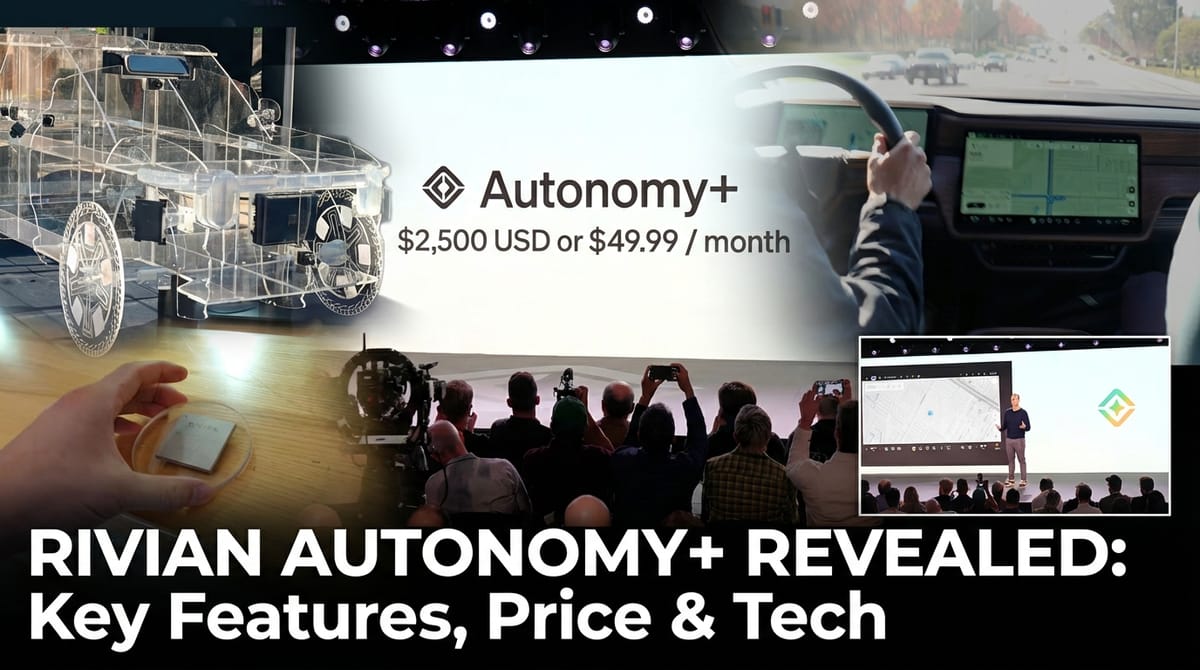
Tesla has dominated the conversation around Full Self-Driving (FSD) for nearly a decade, a factor that has played a significant role in the valuation of tesla company stock. However, the landscape is shifting. Rivian recently invited media to their headquarters for their first-ever AI Day, promising to show the world something big. Is Rivian finally ready to close the gap with Tesla?
I went hands-on with Rivian's new Autonomy Platform to see if their tech is legit or just another promise. Here are the five most important takeaways from Rivian's AI Day that every EV enthusiast and investor should know.
1. A Multi-Modal Sensor Approach
Unlike Tesla, which famously removed radar sensors to rely purely on camera vision, Rivian is doubling down on a fusion of sensors. The Gen 2 R1S features 11 cameras and 5 radars. During the drive, engineers explained that while cameras work great in high visibility, radar provides critical redundancy and confidence in adverse conditions like fog or blinding sunlight.

They even demonstrated how their system uses "end-to-end" learning, meaning the car learns from human driving data rather than just following hard-coded rules. This allows the vehicle to handle complex situations more naturally, though they noted the upcoming R2 platform will also include LiDAR for even greater precision.
2. Real-World Performance is Promising but Cautious
So, how does it actually drive? In our test ride, the "Rivian Autonomy+" system handled stop signs, lane changes, and merging smoothly without any phantom braking. However, it is currently programmed to be extremely cautious.

During one segment, the vehicle encountered a complex intersection with a red left-turn light but a green straight signal. The car hesitated and crept forward, confusing the system enough that the safety driver had to intervene. While tesla company stock bulls might point to FSD's ability to handle these edge cases more aggressively, Rivian's safety-first approach is evident. It currently won't turn right on red, though updates with "mild, medium, and spicy" driving styles are coming.
3. Aggressive Pricing Strategy
Perhaps the biggest shock of the event was the price point. Rivian announced that the Autonomy+ package will cost just $2,500 (or a subscription of $49.99/month).

This is roughly one-third the cost of Tesla's Full Self-Driving package. For consumers, this lowers the barrier to entry significantly. For market analysts tracking tesla company stock, this aggressive pricing suggests Rivian is aiming for mass adoption rather than high-margin software sales exclusively for early adopters.
4. In-House Silicon: The Rivian Autonomy Processor
While many competitors rely on standard Nvidia chips, Rivian revealed they have developed their own custom AI chip in-house. This move allows for tighter integration between software and hardware, similar to Tesla's strategy.

By controlling their own silicon destiny, Rivian can optimize performance and costs. This level of vertical integration is rare in the automotive world and signals that Rivian is transitioning from just a car manufacturer to a serious tech contender.
5. "Agentic" AI Integration
Finally, Rivian showed off features that go beyond just driving. They introduced an "agentic framework" that allows the car's AI to interact with other digital ecosystems. In a demo, the system was able to check a Google Calendar, identify a meeting location, find highly-rated coffee shops nearby, and even draft a text message to a friend with the location details.

This integration of lifestyle AI into the driving experience separates them from the pack, offering a glimpse into a future where your car is a digital assistant, not just a transportation device.
Conclusion
Rivian's AI Day proved that they are not just copying the market leaders; they are innovating with a unique sensor suite, in-house chips, and a highly competitive price point. While the system still has some growing pains regarding complex intersections, the foundation is solid. As competition heats up, the monopoly on autonomy is fading, which is a key narrative for anyone following tesla company stock and the broader EV market.