NVIDIA Self-Driving Test: 6 Reasons This Tech Rivals TSLA Stock Stock Potential
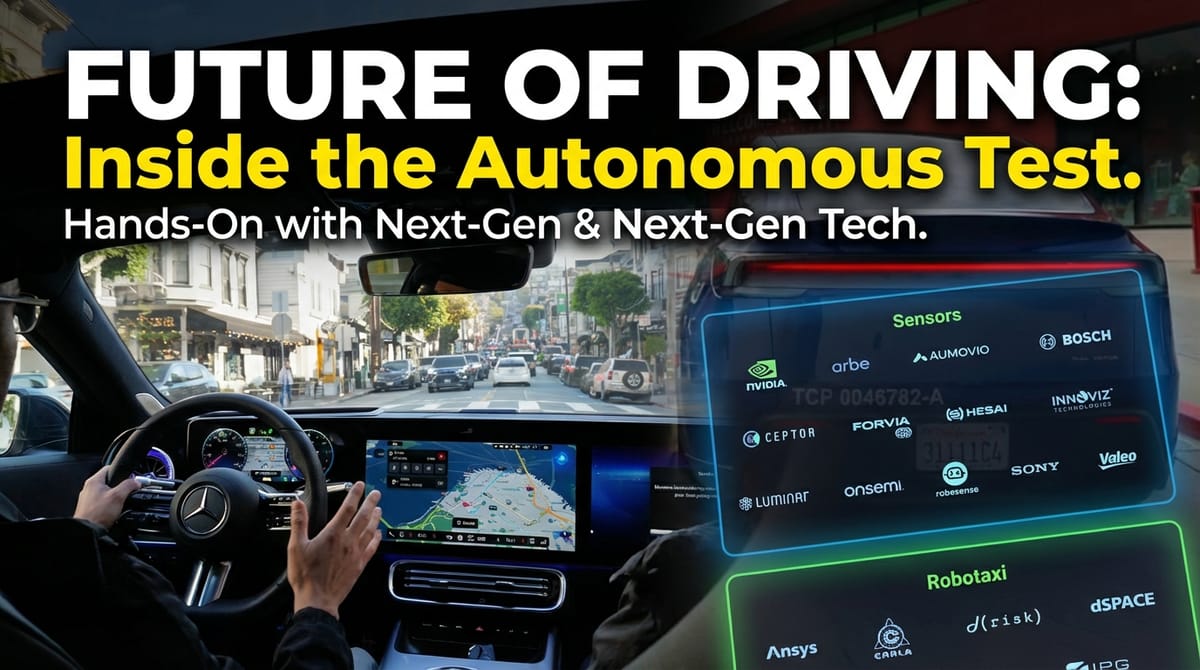
NVIDIA is widely known as the titan of AI chips, powering everything from data centers to gaming rigs. But on the streets of San Francisco, the company is proving it is also a dominant force in the automotive world. I recently had the exclusive opportunity to ride in a Mercedes-Benz powered by NVIDIA's autonomous driving platform, a system that serves as the brain for major automakers like Mercedes, Lucid, and even robotaxi startups like Zoox and Waymo.
While the world watches the volatility of tsla stock stock, NVIDIA is quietly building the infrastructure that could allow the rest of the automotive industry to catch up to—and potentially surpass—Tesla's Full Self-Driving capabilities. Navigating the chaotic, hill-filled streets of San Francisco, this test drive revealed exactly how advanced their "ecosystem" approach has become.
Here are six key takeaways from my ride in a car driven by NVIDIA's cutting-edge AI.
1. It Is the Brain of the Industry
Unlike Tesla, which builds a vertically integrated system for its own cars, NVIDIA acts as an arms dealer for the entire automotive industry. Their technology powers a vast array of vehicles, from consumer luxury sedans like the Mercedes S-Class and Lucid Air to fully autonomous robotaxis like Zoox.

During the test drive, it became clear that NVIDIA isn't just selling chips; they are providing a full stack of hardware, software, and simulation tools. This allows legacy automakers to leapfrog years of development. For investors analyzing tsla stock stock versus the broader market, NVIDIA's strategy of enabling the competition creates a fascinating dynamic.
2. A Hybrid Approach to Safety
One of the most distinct technical differences highlighted during the drive was NVIDIA's software architecture. The system uses a "dual-stack" approach:
- End-to-End AI Model: This modern neural network handles most driving tasks, learning from vast amounts of video data similar to how Tesla's FSD V12 operates.
- Classical Safety Stack: Running in parallel, this rule-based system acts as a guardian. It ensures the car adheres to strict traffic laws, such as not turning right on red when explicitly prohibited.
This combination offers the smoothness of human-like intuition with the rigid safety of hard-coded rules.
3. The "Battle of the Bots"
San Francisco is the ultimate proving ground for autonomous vehicles (AVs), and the density of AVs is so high that they are now interacting with each other.
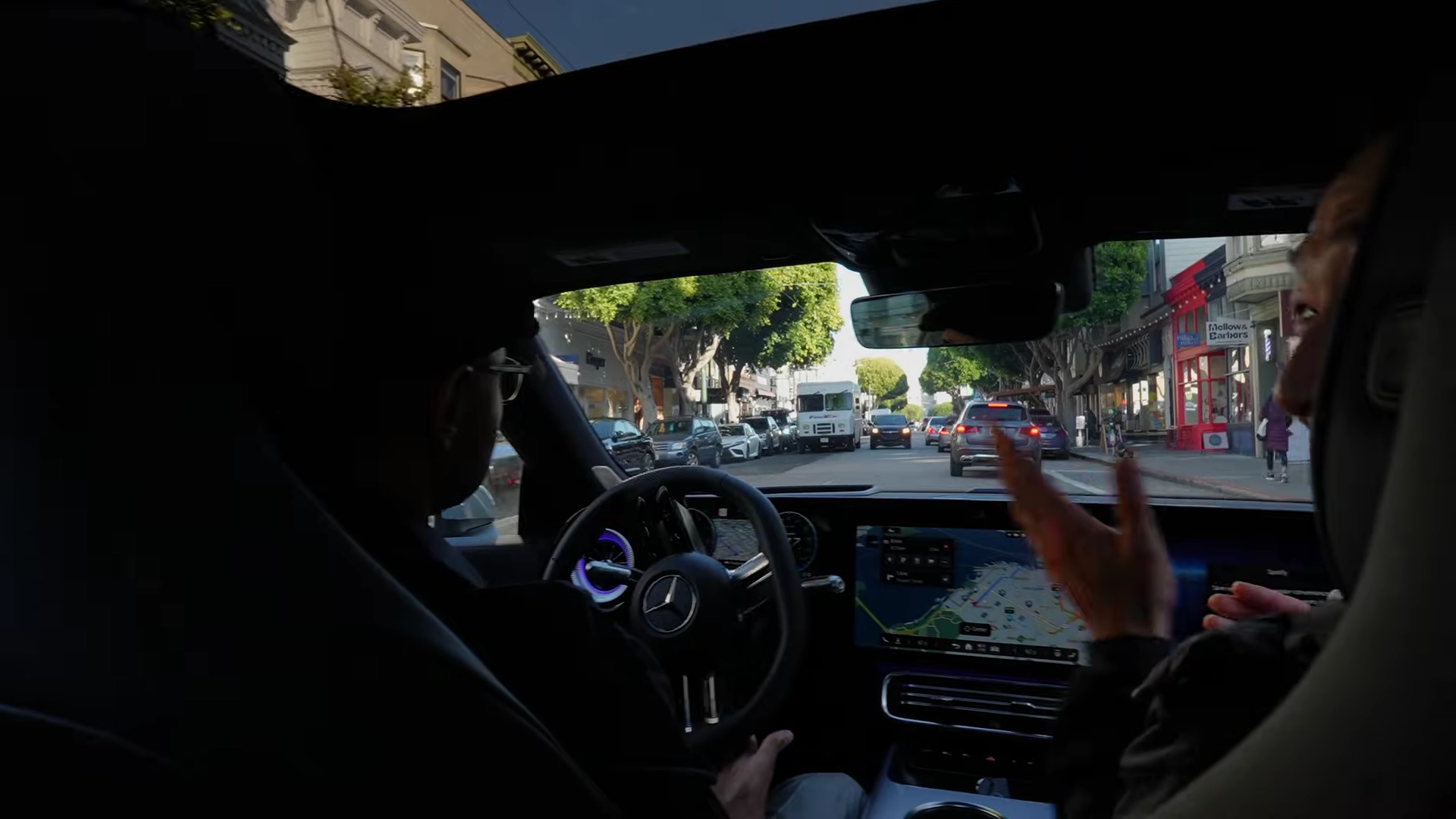
In one memorable moment, our NVIDIA-powered Mercedes engaged in a standoff with a Waymo robotaxi at a four-way stop. Both vehicles inched forward, detected the other's movement, and braked. The NVIDIA system successfully read the Waymo's intent and yielded, preventing a potential gridlock or collision. It was a surreal glimpse into a future where machines negotiate right-of-way without human intervention.
4. Understanding Human Gestures
Driving isn't just about following lines on a road; it's about social interactions. A major challenge for AVs is interpreting non-verbal cues from pedestrians and other drivers.

During the drive, we encountered a pedestrian who wasn't just crossing the street but actively communicating. She waved her hand to signal the car to proceed. Remarkably, the car's perception system recognized this gesture and understood it as permission to go. This level of nuance is critical for Level 4 autonomy.
5. Hardware Supremacy: Orin vs. Thor
The vehicle we tested was running on NVIDIA's Orin system-on-a-chip, which is currently the industry standard for high-performance automotive compute. However, the future lies with Thor, NVIDIA's next-generation superchip designed for Level 4 autonomous driving.

Thor integrates the latest GPU architecture to handle massive AI workloads. While Tesla optimizes its custom AI4 chips for efficiency and vision-only processing, NVIDIA creates powerhouse chips that can support multiple sensor modalities—cameras, radar, and LiDAR—simultaneously. This computational brute force allows for greater redundancy and safety margins.
6. The Ecosystem Enabler
Perhaps the biggest takeaway is NVIDIA's philosophy. They function as an "ecosystem enabler." An automaker can buy just the chips, or they can license the entire software stack and simulation platform.

This flexibility is attractive to companies like Lucid, which recently announced plans to deliver Level 4 autonomous EVs using NVIDIA's technology. By lowering the barrier to entry for autonomy, NVIDIA ensures that advanced self-driving features won't be a monopoly held by a single car manufacturer.
Conclusion
The ride was arguably the most boring roller coaster I've ever been on—and in the world of autonomous driving, "boring" is the highest compliment. The system handled construction zones, emergency vehicles, and aggressive San Francisco drivers with a natural smoothness that felt incredibly safe. As the battle for autonomy heats up, keeping an eye on tsla stock stock is important, but ignoring the massive ecosystem NVIDIA is building would be a mistake.