5 Massive Updates Driving Tesla (NASDAQ: TSLA) Forward
Whether you're an investor tracking Tesla (NASDAQ: TSLA) or an owner eager for the next software update, keeping up with the electric vehicle giant can feel like a full-time job. Right now, the company is balancing near-term delivery fluctuations with massive, long-term investments in autonomy and artificial intelligence.
From Wall Street upgrades to leaked Robotaxi maps and mammoth AI infrastructure projects, here are the top five updates currently shaping the future of Tesla.
1. Wall Street's Bullish Stance on TSLA
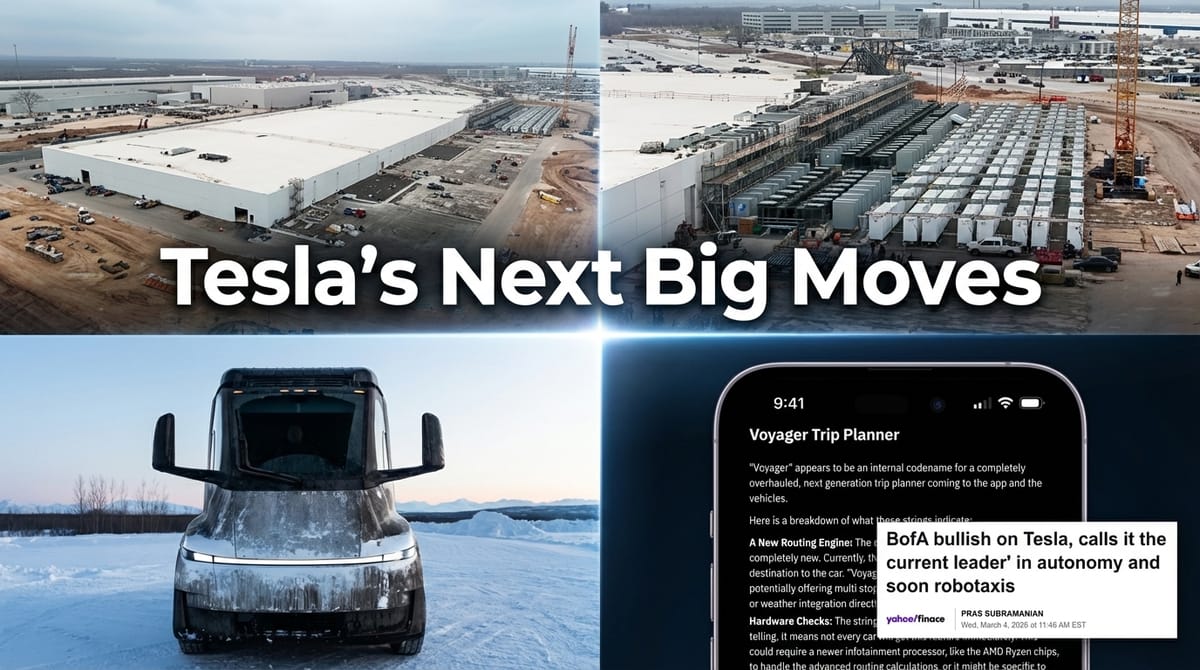
Despite a recent ~4.5% dip over the past month, Tesla (NASDAQ: TSLA) received a significant vote of confidence from Wall Street. Bank of America recently reinstated its coverage with a "Buy" rating and a bold $460 price target.

This upgrade highlights a fundamental debate among analysts: should Tesla be valued simply as an automaker, or as an AI and robotics powerhouse? While car sales currently generate the revenue, future multiples are heavily tied to promises of autonomy, the Optimus robot, and AI dominance.
2. The Robotaxi Rollout: Maps, Pricing, and Rivals
The road to a fully autonomous Robotaxi fleet is complex and highly competitive. Recently, an unofficial map surfaced estimating the current "Unsupervised" Robotaxi geofence in Austin, Texas.

While the operational area remains restricted, Tesla is actively testing pricing elasticity, recently raising the base fare in Austin to $3.25. However, the competition isn't idling. Amazon-backed Zoox is expanding its testing to Dallas and Phoenix while opening a major fleet command hub in Scottsdale, Arizona. Furthermore, Tesla is navigating regulatory hurdles, including a March 9th NHTSA deadline tied to an investigation into FSD traffic law violations.
3. Mixed Signals in Global Sales
Tesla's real-world delivery numbers present a mixed bag across different regions:
- Europe Stabilizing: February saw positive momentum in parts of Europe, with registrations up 55% in France, 74% in Spain, and 32% in Norway. Conversely, UK sales plummeted by 37%.
- China Delivery Times: In China, delivery wait times have dropped to just one to three weeks. While this means faster cars for buyers, it often indicates softer local demand, prompting Tesla to offer aggressive financing options and shift Shanghai production toward European exports early in the quarter.
4. Software Upgrades: "Voyager" and FSD Refining
Tesla's software ecosystem continues to evolve quietly but significantly. Updates 2026.2.9 and 2026.2.9.1 are rolling out, containing FSD Supervised version 14.2.2.5. Notably, this update alters in-car wording to abandon all references to "Autopilot."

Additionally, code sleuths have uncovered references to "Voyager," an overhauled, next-generation trip planner. Voyager promises a more robust routing engine, potentially offering detailed multi-stop route planning, elevation tracking, and weather integration synced directly from your phone. Cybertruck owners are also finally receiving active noise cancellation—a feature enabled by existing hardware that took time to refine in software.
5. Scaling Hardware: Tesla Semi and Cortex 2
On the hardware front, Tesla is pushing boundaries both in vehicles and the infrastructure required to train them.

- Tesla Semi Progress: The new Nevada Semi factory is nearing completion. Meanwhile, the redesigned Semi has been spotted undergoing rigorous winter validation testing in Alaska. The updated production interior boasts 10 exterior cameras, an in-cabin attention monitor, more storage, and dual 16-inch screens.
- Cortex 2 Supercomputer: Perhaps the most crucial development is Cortex 2 at Giga Texas. The first 250 megawatts of this AI data center are slated to come online in April, with a total of 500 megawatts expected by mid-2026.

This massive compute power is the backbone of Tesla's transition into an AI company, providing the training infrastructure necessary to accelerate Full Self-Driving and the Optimus humanoid robot.
Conclusion
The narrative surrounding Tesla (NASDAQ: TSLA) remains split between current automotive realities and future technological breakthroughs. While short-term challenges in global sales and regulatory probes persist, Tesla's relentless push into next-generation software, heavy-duty transport, and unmatched AI infrastructure proves the company is playing the long game.